
Hydroxypropyl Guar:Multi-functional Natural Thickener for Cosmetic Formulations
Hydroxypropyl Guar (HPG, CAS:39421-75-5) is cosmetic-grade nonionic modified polysaccharide formally recorded in China’s Existing Cosmetic Ingredient Catalogue and EU CosIng inventory. Derived from natural guar bean endosperm through controlled hydroxypropylation modification with propylene oxide, the raw material undergoes repeated purification, filtration and fine pulverization to form uniform off-white fine powder. Different from low-cost industrial-grade counterpart, cosmetic HPG executes strict specifications on heavy metal residue, microorganism limit and insoluble impurities during production. Compared with unmodified native Guar Gum which easily agglomerates and precipitates in cold water or high-electrolyte formulas, the introduced hydroxypropyl side chains greatly boost cold-water instant solubility and excellent tolerance against salts, alcohol and varying pH conditions. After multiple safety assessments including skin irritation and sensitization tests, cosmetic HPG is verified non-irritating to human skin, making it a mainstream plant-derived multifunctional additive widely adopted by cosmetic manufacturers all over the world.
| Mechanism of Action on Skin HPG delivers comprehensive skincare benefits depending on physical film-forming capacity and chemical buffering features. Once fully hydrated after contacting skin surface, its long hydrophilic polysaccharide backbone together with branched hydroxypropyl groups regularly arranges and constructs an ultra-thin, breathable biomembrane without blocking cutaneous pores. This compact but permeable film effectively reduces transepidermal water loss (TEWL), locks inherent moisture inside stratum corneum and relieves dryness, peeling and rough skin problems caused by environmental dryness or over-cleansing. In cleansing formulas containing abundant anionic surfactants, nonionicHPG can bind partial irritative surfactant residues remaining on skin surface, stabilize skin natural pH balance and alleviate tight, itchy or reddish uncomfortable feelings after washing. Its mild lubricating property smooths uneven dead cuticle and improves post-application tactile feeling without leaving sticky coating on skin. Additionally, HPG homogenously disperses various skincare active components such as plant extracts and whitening additives inside formulas, helping functional ingredients evenly attach onto epidermis and realize better expected efficacy. | 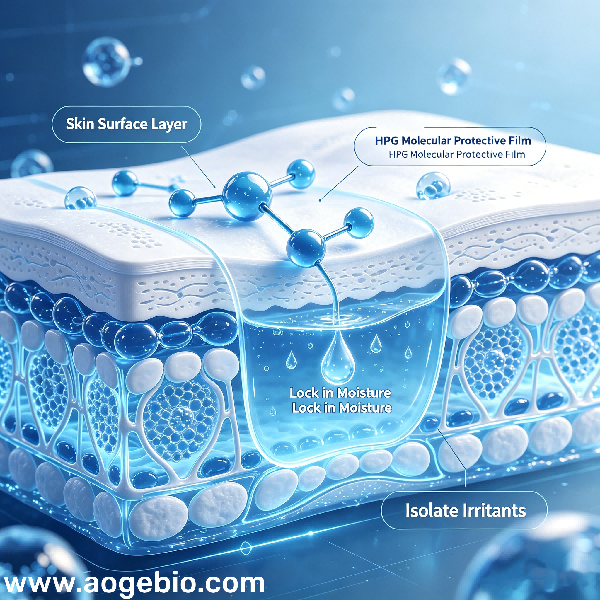 |
Practical Application & Formulation Related Questions and Answers
The recommended safe usage dosage of cosmetic HPG ranges from 0.1% to 1.2%, which is far below legal maximum limit for leave-on cosmetic products, bringing zero safety risk for finished goods. It serves three core roles: rheology thickener, system stabilizer and foam modifier, showing outstanding compatibility with high-concentration salt ingredients and hydroalcoholic formulas containing up to 30% Ethanol such as instant hand sanitizer. In rinse-off products including mild facial cleanser, transparent shampoo and body wash,HPG reinforces foam framework, improves foam richness and reduces irritation induced by high-dose surfactants; for leave-on items like moisturizing gel, essence and sunscreen lotion, it suspends inorganic UV-filter powders and color pigments to avoid product layering and sediment during long-term shelf storage.
Core Formulation Questions & Professional Answers
Q1: How to set proper addition proportion of HPG to balance viscosity and fresh non-sticky feeling in alcohol-based hand sanitizer gel?
A1: Recommended addition range is 0.2%–0.5%. Dosing below 0.2% cannot reach required viscosity and suspension capacity, while over 0.5% leads to sticky residue on skin. Low-viscosity cosmetic HPG is the optimal choice for alcohol sanitizer to achieve desirable consistency and quick-dry refreshing texture.
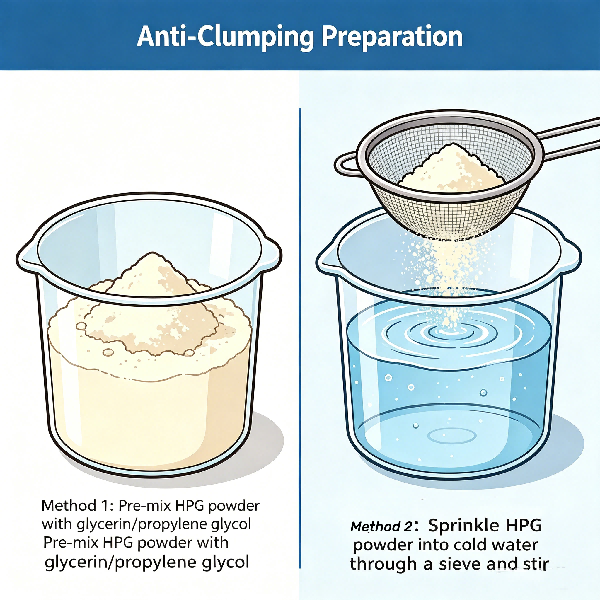
Q2: What pre-dispersion methods can effectively prevent powder agglomeration when dissolving HPG in cold process water?
A2: Two mature methods are available. First, pre-blend HPG powder with glycerin or propylene glycol before adding into water under stirring. Second, sieve HPG slowly into agitated cold water. Both approaches eliminate fish-eye lump and achieve full dissolution within 5–10 minutes.
Q3:Will HPG produce turbidity when matched with cationic conditioning polymers in transparent shampoo, and how to solve the compatibility problem?
A3: High-purity cosmetic HPG shows perfect compatibility with cationic polymers without turbidity. Cloudiness is only caused by impure industrial-grade HPG. Maintain system pH between 6.5–7.5 and select qualified cosmetic-grade HPG to guarantee long-term transparency of finished transparent shampoo.
Q4: What viscosity grade of HPG should be selected for lightweight essence and dense moisturizing lotion separately?
A4: Low-viscosity HPG (2000–3000 mPa·s) fits lightweight essence, toner and transparent gel for fluid non-heavy texture; medium-viscosity HPG (3000–5000 mPa·s) is suitable for rich moisturizing lotion to stabilize emulsion system and improve spreading performance.
Q5: What processing temperature and pH range can maximize the long-term storage stability of finished products containing HPG?
A5: Ideal processing temperature is 25–60°C; temperature above 80°C degrades polysaccharide chain and decreases viscosity. Suitable formula pH is 6.0–8.5. Extreme acid or alkaline environment will damage HPG structure and result in viscosity drop and formula separation during storage.
Terminal Applications & Market Prospects
Driven by global clean beauty and mild-sensitive skincare consumption trend, cosmetic-grade HPG market gains steady year-by-year growth. More global cosmetic brands abandon synthetic chemical thickeners and shift toward biodegradable plant-based raw materials like HPG to satisfy consumers’ pursuit of natural and clean ingredients. Sharply rising demand for sensitive-skin targeted personal care products further boosts continuous market consumption, while emerging markets covering Southeast Asia, Middle East and Latin America become key growth engines thanks to improving local disposable income on beauty care. Its finished terminal application covers full cosmetic categories: skincare segment includes mask essence, sensitive skin repair gel and after-sun soothing lotion; daily cleansing segment involves mild facial wash, clear shower gel and alcohol no-rinse hand sanitizer; color cosmetic field applies it in water-based primer, liquid foundation and transparent lip gloss. Benefiting from low irritation property, HPG is also widely used in infant body lotion and moisturizing wet wipe liquid. Ongoing technical optimization on raw material purification and customized viscosity grades continuously opens new application scenarios. With consumers increasingly prioritizing safe, plant-derived cosmetic raw materials, cosmetic-grade Hydroxypropyl Guar is poised to maintain stable demand growth and holds promising long-term market prospect globally.
Name: Chloe Liang
Email: sales10@aogubio.com
Whatsapp: +86-18161805635
Website: www.aogebio.com